Excel is not the problem: The old way of using it is.
Apr 21, 2026
Blog
If you’ve spent five minutes in a FinTech or MLOps conference lately, you’ve heard the same sermon: "Excel is dead. It’s manual, it’s risky, and it’s the enemy of progress. You must move everything into Python, Jupyter, or our proprietary dashboard."
It’s a compelling narrative for software engineers. But ask the twenty-year veteran managing a large portfolio, and you'll get a very different answer. He didn't build his career on what's fashionable. He built it on what works.
The truth? Excel is not the problem. It is the most flexible, widely understood, and powerful UI ever created for data and financial decision-making. Trying to take Excel away from a Portfolio Manager (PM) is foolish.
The real problem isn't Excel itself, it’s the disconnect between the sophisticated research happening in Python and the actual execution happening in the spreadsheet.
The Excel Problem in Quantitative Research
Today, the workflow in most firms looks like this:
The Quant spends weeks developing a brilliant risk-parity model in a Jupyter Notebook.
The IT Team spends more weeks trying to wrap that model into an API.
The Portfolio Manager gets frustrated because they can’t easily play with the model’s parameters inside their existing trading sheets.
The result? The model sits on a shelf, and the PM goes back to a simplified version they built themselves in, you guessed it - Excel. This is the problem: the point where high-end research fails to reach the person pulling the trigger on a trade.
Don’t Replace the Interface. Supercharge the Engine.
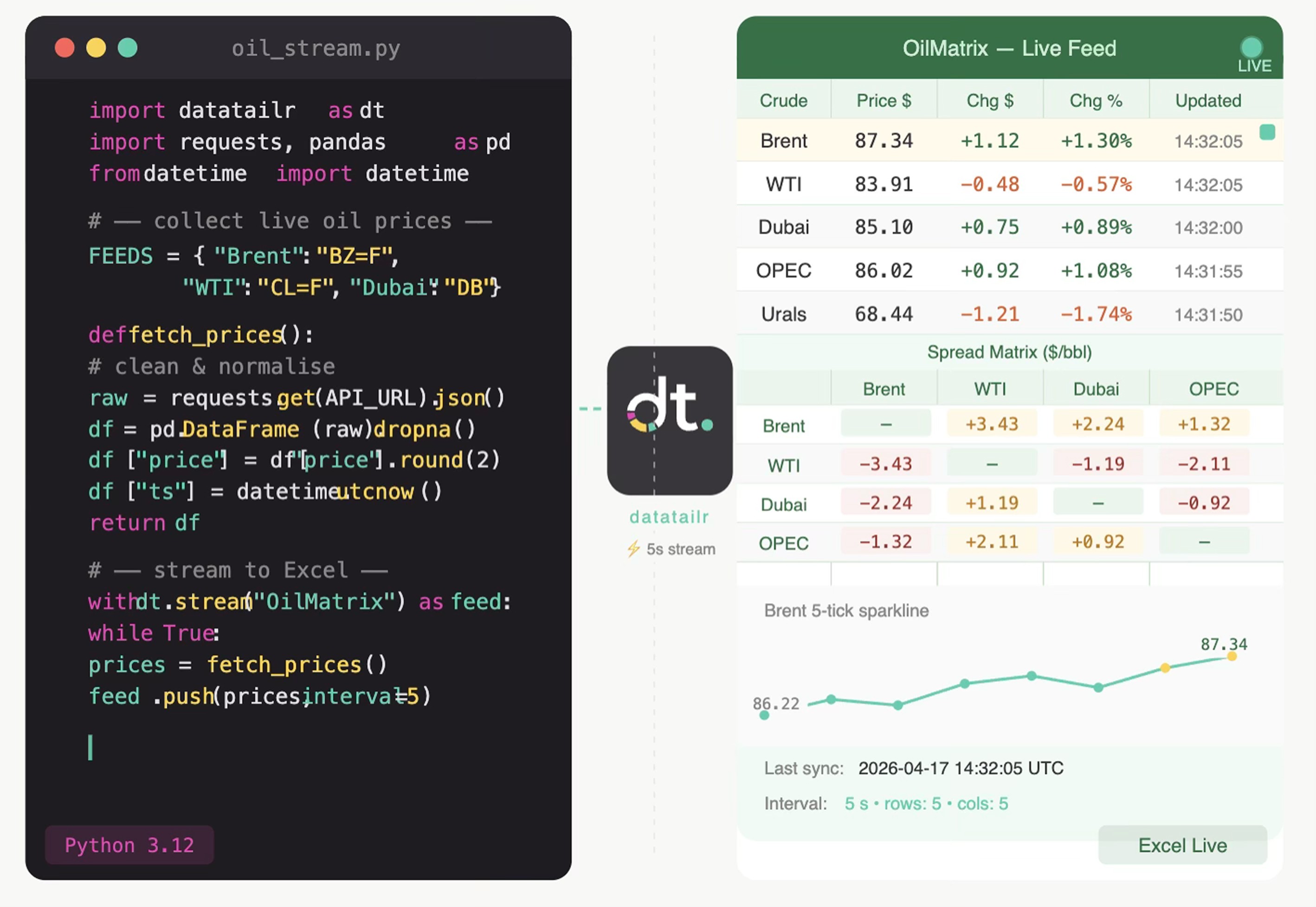
At Datatailr, we took a different path. Instead of trying to force PMs into a coding environment they don't want, we decided to bring the power of the cloud and Python directly into Excel.
1. Python Logic, Cell Simplicity
With Datatailr, a Quant can write a complex pricing model in Python and publish it as a native Excel function. To the PM, it looks like any other formula. They type =GET_ENERGY_RISK(A1, B1) and hit enter. Behind the scenes, Datatailr takes that command, executes it on a high-performance cloud cluster, and returns the result in seconds.
2. Computing at Scale, UI at Ease
The PM isn't running a heavy simulation on their laptop - which would likely crash Excel. They are using Excel as a frontend for thousands of cloud cores. You can run a 10,000-path Monte Carlo simulation from a single cell without crashing your laptop
3. One Version of the Truth
Because the logic stays in the Python code managed by the quants writing the code, you eliminate risk of someone emailing an older version. There are no more broken macros or hidden formulas. When the Quant updates the model in the cloud, every member who has access to the spreadsheet gets the updated version instantly.
Closing the Loop Between Research and Execution
In 2026, the most successful firms won't be the ones that migrated away from Excel. They will be the ones that successfully integrated their deep-tech research with their front-office execution.
By bridging the gap between the Quant’s code and the Manager’s spreadsheet, Datatailr does something that no other MLOps platform can: it makes the research useful. It turns a static model into a living tool that can be used to make huge decisions in real-time.
The Datatailr Advantage
Technology is only as good as the decisions it enables. Whether you are navigating the volatile energy markets or hunting for Alpha in global equities, your goal is to be faster, smarter, and more secure than the competition.
Stop fighting your tools. Start integrating them and accelerating your results.

Related Articles



1177 Avenue of The Americas, 5th FloorNew York, NY 10036
Useful Link