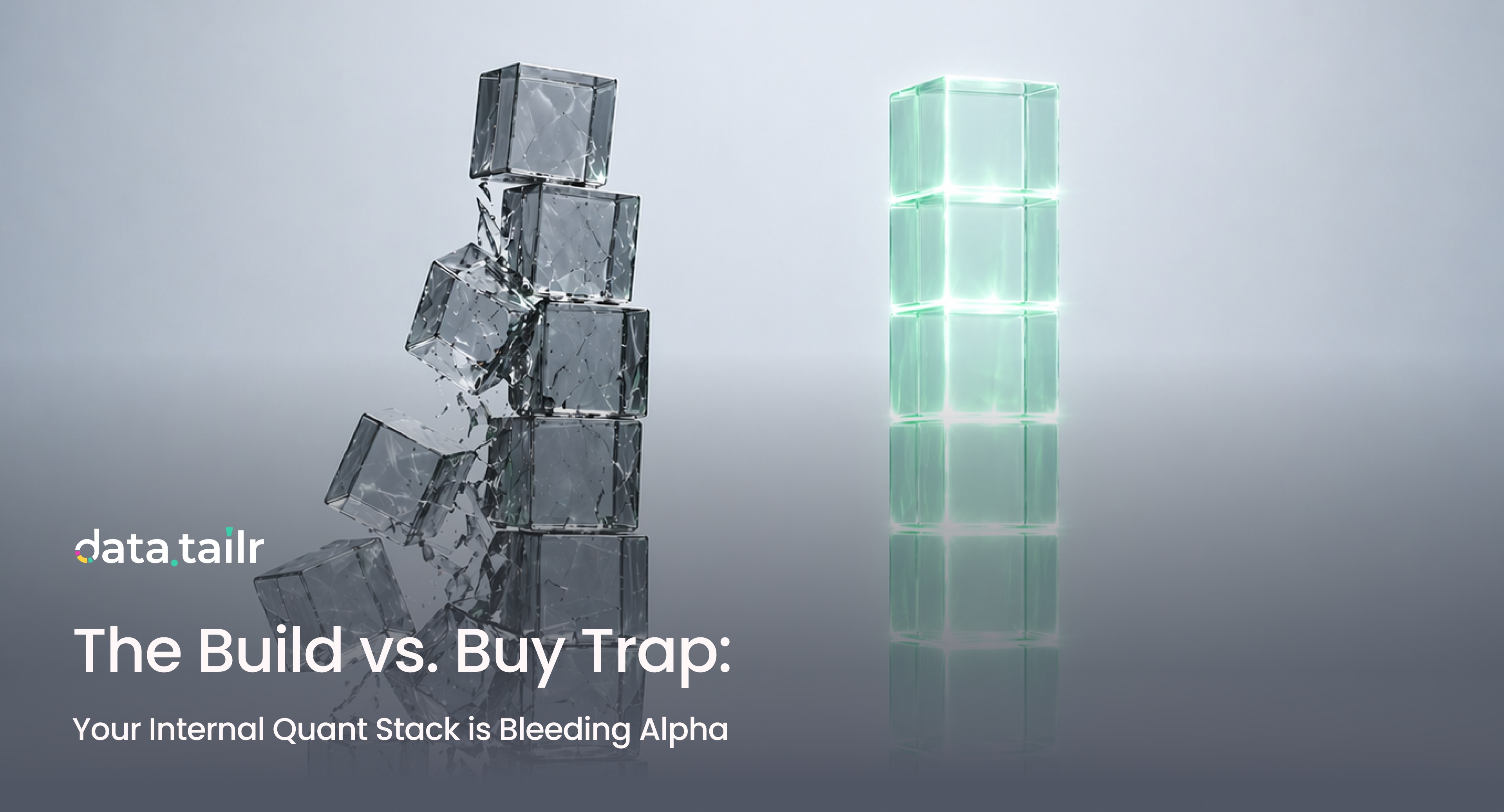
The Build vs. Buy Trap: Your Internal Quant Stack is Bleeding Alpha.
Apr 21, 2026
Blog
It is the classic question for any CEO/CTO: "Why pay for a platform when we have an in-house team? We can build our own research stack on top of Kubernetes and AWS. It’ll be exactly what we need, and we’ll control everything."
It sounds strategic. But in 2026, it is often a very expensive mistake a financial institution can make.
While your internal team is undoubtedly brilliant, building a world-class quantitative research platform is no longer a side project for a DevOps team. It is a full-scale engineering endeavor that, if managed poorly, turns into a Legacy Trap - a system that is outdated the moment it is finished, sucking up resources that should be spent on generating Alpha.
The Allure of the In-House Solution
The motivation to build internally usually stems from three desires:
Total Control: The belief that our needs are unique
Security: The fear that third-party tools are "black boxes"
Cost Savings: The illusion that "we’re already paying for these engineers, so the software is essentially free."
However, this logic fails to account for the Second-Order Effects of software development in the age of Cloud-Native AI.
1. The Maintenance Vortex
Building the platform is only 20% of the journey. The remaining 80% is maintenance. In 2026, the technology stack is moving at a breakneck pace. Python versions update, security patches for Kubernetes are released weekly, and new libraries like Polars or Dask require constant architectural adjustments.
When you build an internal platform, your best engineers stop being innovation drivers and become support teams. They spend their days fixing broken pipelines, updating drivers, and troubleshooting why a specific researcher’s environment won't spin up.
The Datatailr Contrast: We have an entire company whose only job is to ensure the workflows never break. When you use Datatailr, you outsource the infrastructure so your team can focus only on their strategy.
2. The Talent Attrition Risk
Internal platforms are often the passion project of one or two talented engineers. But what happens when those engineers are headhunted by a competitor?
We have seen this play out dozens of times: A firm builds a complex, bespoke grid-computing system. The lead architect leaves. Six months later, the system is a black box that no one knows how to update. The Quants start complaining, the IT team is afraid to touch it, and eventually, the firm has to scrap the entire project and start over.
The Build Trap: Bespoke systems create dependency.
The Buy Advantage: Datatailr provides a standardized, documented, and constantly evolving environment that is ready from Day 1 and doesn’t need a rebuild.
3. The Feature Parity Gap
A dedicated platform company like Datatailr invests millions of dollars into User Experience (UX). We obsess over the Excel-to-Python Bridge, the speed of bursting to thousands of VMs, and the seamlessness of the integration.
An internal team, no matter how talented, will always treat user experience as a second-tier priority. They build functional tools, not easy to use ones. The result? Your Quants find the internal tool clunky and restrictive. They start bypassing it - saving data to their local drives, using unsanctioned cloud instances, and creating shadow IT risks just so they can work at the speed of their thought.
4. The "Data Gravity" Miscalculation
Internal teams often build platforms that assume data is static. They build data lakes that require complex ETL (Extract, Transform, Load) processes.
But as we discussed earlier, in 2026, Data Gravity is the enemy. The most efficient way to work is to never move the data. Building a "Zero-Movement" architecture is an incredibly complex engineering feat that requires deep integration with cloud providers at the kernel level. Most internal teams simply don't have the time to go that deep. They settle for good enough wrappers that move data around, unknowingly racking up massive egress bills and slowing down research by hours - or days.
The Financial Reality: Total Cost of Ownership (TCO)
If you look at the TCO of an internal platform, the numbers are staggering.
Engineering Salaries: 3-5 full-time engineers ($750k - $1.2M/year).
Cloud Waste: Inefficient scaling and idle instances (often 30% of the cloud bill).
Opportunity Cost: The value of the trades not made because the platform was down or slow.
When you add it up, the annual license for a platform like Datatailr isn't a cost—it’s a savings. It is a way to hedge against technical debt and ensure that your firm’s intellectual capital is spent on trading, not tooling.
To make this tangible, we've put together an interactive tool - plug in your needs and see the true cost of building in-house.
Focus on the Alpha, Not the Infrastructure
In the early days of the internet, every company built its own web server. Today, that would be considered insanity. You use AWS, Google, or Azure.
The same shift is happening in Quantitative Research. The plumbing of cloud orchestration, VPC security, and Excel-Python integration is becoming a utility. You shouldn't be building your own utility.
Your competitive advantage is your data and your algorithms. Everything else should be Off-the-Shelf excellence.
Stop building yesterday’s legacy. Start using today’s edge.
It’s time to Buy the best, so you can Build the future.
Related Articles


1177 Avenue of The Americas, 5th FloorNew York, NY 10036
Useful Link